
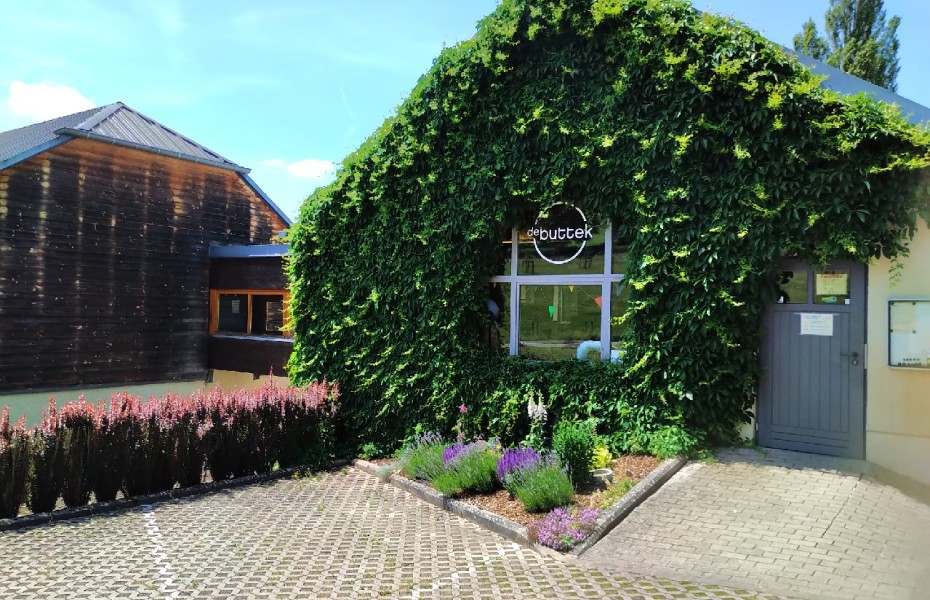
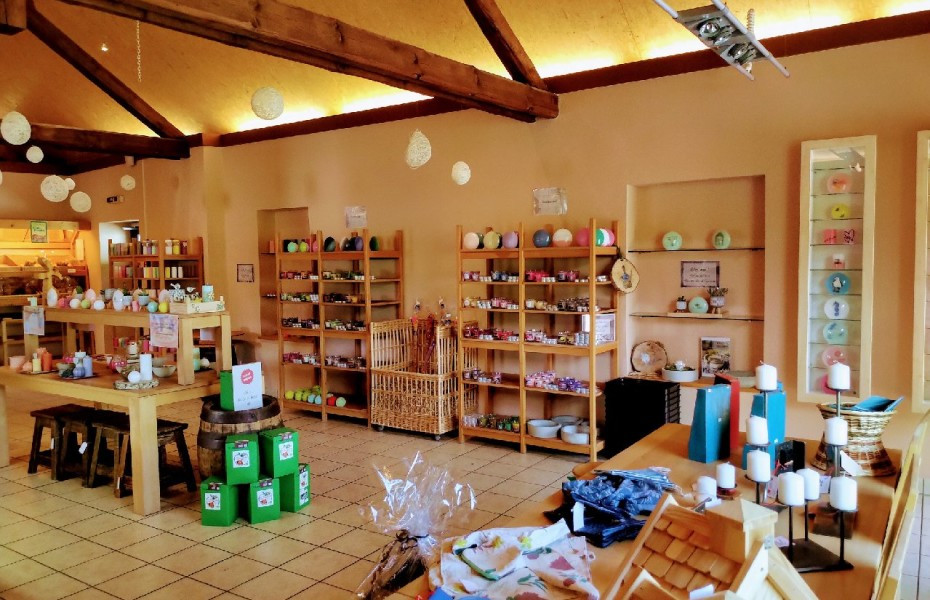
Our shop "De Buttek" welcomes you every day from Monday to Friday from 8.00 am to 4.00 pm or if you like on one of the weekly markets in Diekirch or Ettelbruck.
The shop is ideally located at the centre of our farm, not far away from the town centre of Ettelbruck.
We offer:
- Grocery products (**):
Organic groceries, fresh products from our kitchen, organic seasonal vegetables cultivated on our farm, home-made jams, jellies and syrups, and apple juice from the Haff.
- Shopping:
Candles designed and manufactured in our workshop, firelighters made by our gardening team, decorative objects for the home or garden, hygiene products, handmade wicker baskets.
Take advantage of the pleasant settings of the farm relaxing with a glass of juice or maybe after a walk (*). Our shop provides an area of relaxation where you can read your newspapers or just simply enjoy the view of the surrounding hills and the orchards of the farm.
Buildings are also accessible to people with reduced mobility.
(*) Local trail "E" (5.2 km) or nature trail "Haff Ditgesbaach" (3km) /www.ettelbruck.lu /www.cactus.lu Yuppi Léierpad
(**) organic (LU BIO 02) and conventional
Contact :
Haff Ditgesbaach / Shop
Phone : 26 81 49 - 27
Email : buttek@atp.lu